ICAR- IGFRI- Western Regional Research Station, Avikanagar- 304501, District- Tonk, Rajasthan
Thrust Areas
- Germplasm enrichment, evaluation and maintenance of annual and perennial grasses and legumes for arid and semi-arid region.
- Genetic improvement of annual and perennial grasses and legumes for arid and semi-arid region.
- Development of production systems under semi-arid region.
- Seed production of range grasses and legumes.
- Transfer of technology to the end users.
Working Groups
- Fodder production technology
- Forage seed production technology
- Horti-pasture, silvi-pasture system
- Pasture establishment technology
Brief Introduction
ICAR- IGFRI- Western Regional Research Station (WRRS) was started on September 21, 1987 in the campus of CSWRI, Avikanagar, Tonk (Rajasthan). It is located at 27°17’N latitude and 75°22’E longitude at an elevation of 326 msl. about 85 km from Jaipur on Jaipur-Kekri-Bhilwara road within the campus of CSWRI, Avikanagar. During 1987-2006 type-IV and during 2007-2010 Type-V residential quarter was used as office. The office was shifted in newly built office-cum-laboratory building during February, 2011. Station has about 60 acres farm land. Average annual rainfall of the region is about 600 mm extending over the period from July-September with few showers during winter. The soil of research farm is sandy in texture having water holding capacity of 32.5%, pH above 8.0, and organic carbon 0.20 per cent.
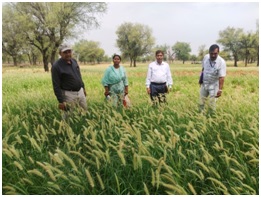
Anjan grass variety Bundel Anjan-4
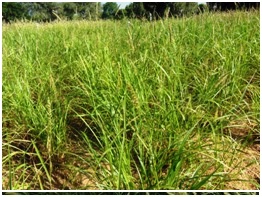
Dhaman grass variety Bundel Dhaman-1
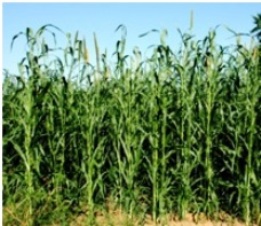
Dual type pearlmillet variety Avika Bajra Chari (AVKB-19)
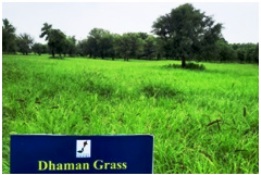
Dhaman grass variety Bundel Dhaman-1
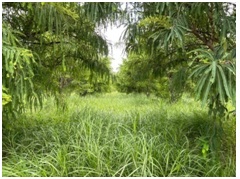
Aonla based Horti-pasture system
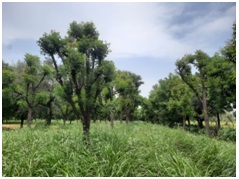
Neem based Silvi-pasture system
1. Major AchievementsDeveloped fodder crop varieties
- Avika Bajra Chari (AVKB-19) — Dual type pearlmillet variety developed and released for cultivation in North-West Zone comprising states of Haryana, Rajasthan, Punjab and Gujarat (SO 2187(E) 27.08.2009).
- Bundel Anjan-4 (IGFRI-67-365) — Released for Central Zone. Green fodder yield: 375 q/ha. (SO 99(E) 06.01.2020).
- Bundel Dhaman-1 (IG-96-706) — Released for North-West Zone. Green fodder yield: 140 q/ha. (SO 99(E) 06.01.2020).
2. Developed fodder and seed production technologies of pasture grasses and legumes
- Recommended application of 2% foliar spray of KNO3 in Cenchrusciliaris at panicle initiation stage for improvement of proportion of filled seed (23.4%), germination (21.2 %) and seed yield (28.7%).
- Enhanced germination of Clitoreaternatea (Range legume) by physical scarification: Highest germination (90%) was achieved by nicking followed by sand paper scarification which increased germination up to 70.5% against control (6.5%).
- Seed treatment of Anjan grass (Cenchrusciliaris): Growth harmone GA3 (200 ppm) for 24, Thiourea (0.6%) for 18 hr and KNO3 (0.4%) for 24 hr are recommended for achieving grass germination upto 45% .
- Off season seed production for combating demand of Anjan/Dhaman grasses seed: Evaluated seed production potential of seven genotypes of each Cenchrusciliaris and C. setigerus during three seasons in a year (Monsoon, Autumn and Spring season) for three years indicated that it is possible to produce seed of Cenchrus grasses during three seasons in a year.
- Seed viability behaviour of fluffed and defluffed seed of range grasses:C. ciliaris (Anjan grass) Lasiurusscindicus(Sewan grass)and Pennisetumpedicellatum(Dinanath grass) in different containers suggested that defluffing of seed reduced the volume of seed by 5-6 times accordingly that saved the cost of packaging and transportation of the grass seed. Fluffed seed can be stored for > 2 years while delfulffedseed can be stored only up to 6 months.
- Recommendation of storage container for range grasses: Among the storage containers, poly bag >700 gauge and Aluminum bag found effective in comparison to cloth bag, polylined HDPE bag and polybag <300 gauge for maintaining the seed viability during storage in fluffed as well as defluffed seed in (Anjan, Sewan, Dinanath and Guinea grasses).
- Developed seed standards for HeteropogonandSehimagrasses: Among the different dormancy dissipating methods such as heating the seed at 40oC for 120 hours, and seed treatments with KNO3, Thiourea, GA3, ether and H2SO4; treatment with GA3 at 750 ppm for 18 hrs found most effective in dissipating the seed dormancy which led to 72% germination in Heteropogon, whereas ether was found least effective (1.3% germination). Evaluation of germination medium (Top of paper, Between paper and Sand), temperature (25oC, 35-20oC and 30-20oC) and presence/absence of light indicated that Top of paper (TP) medium at 25oC temperature in dark were found suitable method in Heteropogonand Sehimagrasses seed germination evaluation.
- Weed Management in Cenchrus grass: Application of 2, 4-D @ 0.5 kg a.i./ha at 20 DAS (Early post emergence, EPE) could be recommended for efficient weed control, uniform crop establishment and higher productivity of Cenchrussetigerus..
- Standardised cutting schedule for qualityseed production in Cenchrusciliaris(Anjan grass): In rainfed regions cutting Anjangrass seed crop on 20th July and allowed regeneration for crop growth and seed formation is recommended for highest seed production in semi-arid areas while cutting seed crop on 20thAugust gave better seed quality though seed yield was low.
- Canopy management effects on Neem based silvopasture system: The 75% lopping of 10-year-old trees is recommended for neem-based silvopasture systems in semi-arid rainfed regions of Rajasthan for higher carbon sequestration potential, soil health, and fodder productivity of the neem-based silvopastoral system.
Success Stories
Grassland development on common properties resource (CPR) on about 70 ha in Soda village, District Tonk (Raj) during 2013. Technical support along with seed/ rooted slips of Anjan grass (Cenchrusciliaris), Dhaman grass (C. setigerus), Dinanath grass (Pennisetumpedicellatum) and saplings of fodder tree Soobabul (Leuceanaleucocephala), Ardu (Ailanthus excelsa) and Neem (Azadirachtaindica) were supplied.
IGFRI-WRRS, Avikanagar assisted in the development of pasture in 18 hectare area atNagnechiGaushala also known as Khema Baba Gaushala situated at Akadara village, Tehsil-Baytu, District-Barmer, Rajasthanwhich increased fodder availability many fold for the animalsin the Goshaladuring 2024. It has been observed that the community started following scientific pasture management techniques. The observations on fodder yield were recorded. The average fodder productivity of the pasture was recorded 58 quintal/hectare. Along with enhanced fodder availability the quality of fodder improved with the intervention of improved varieties of grasses such IGFRI-3108 of Cenchrusciliaris and Bundel Dhaman-1 of Cenchrussetigerus. Since these grasses have wide range of adaptability traits firmly got established in the pasture. The committee was also encouraged for seed production for self-sustainability of the community pasture consequently the pasture management committee harvested 20 kg seed from the pasture for gap filling and rejuvenation of pasture.
Ongoing Research Projects
| Project Code |
Title |
Team |
| CRSCIGFRISIL20240801 |
Standardization of Agro-techniques for seed production of Cenchrus grasses in various seasons under semi-arid climate of Rajasthan |
H.S. Meena, R.P. Nagar |
Staff Position
Scientific Staff
| No. | Photo | Scientist | Designation | Subject |
| 1 |

| Dr. R.P. Nagar |
Principal Scientist and OIC |
Seed Science & Technology |
| 2 |

| Dr. H.S. Meena |
Scientist |
Agronomy |
Administrative Staff
| S.No | Image | Name | Designation |
|---|
| 1 |  | Sh. Yash Pal Singh | Asst. Admn. Officer |